
Health AI · Deep Tech · Advisory
The Silent Genius Problem: How Tech Hiring Breaks the People Who Quietly Fix Everything
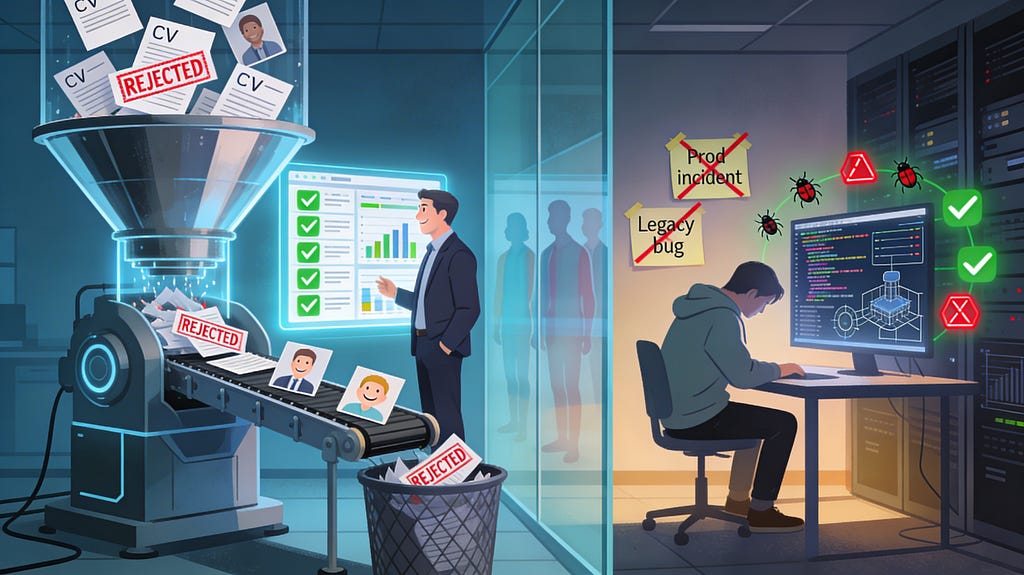
I used to think our hiring problems were about "the market": not enough talent, not enough applicants, not enough time. Then I looked at my own team and realized something uncomfortable: my most valuable engineers would fail every step of our own hiring funnel, not because they weren't good enough, but because the funnel measures the wrong things.
Key takeaways
- The author realized hiring issues reflected internal funnel design, not just external market scarcity.
- Most valuable engineers would fail the team's own hiring process despite strong real-world performance.
- Current hiring funnels overmeasure visible interview skills and undermeasure quiet, essential problem-solving.
I used to think our hiring problems were about “the market.” Not enough talent. Not enough applicants. Not enough time. Then I looked at my own team and realized something uncomfortable: my most valuable engineers would fail every step of our own hiring funnel.
Not because they weren’t good enough — because they were different.
They were the ones who sat in the corner in meetings, said almost nothing, then pushed a commit at 23:47 that quietly fixed three long‑standing production bugs and cleaned up a terrifying tangle of legacy code. They didn’t ask for credit. They didn’t perform. They just delivered.
And every single one of them would have been filtered out by our HR screens, AI filters, or “culture fit” interviews.
That’s when it clicked for me: the way we hire is systematically optimized to reject exactly the people we most desperately need.
When the Best Engineer in the Room Fails the First Interview
I remember one engineer in particular.
Let’s call him M.
On paper, M was “fine.” Not spectacular. No FAANG badges. No perfectly curated LinkedIn. His CV was short, undersold, and written like someone who hates talking about themselves — which, as I later learned, he did.
In the HR screening, he barely spoke. Short answers. Long pauses. Zero “energy.” If you looked at the feedback, it read like a rejection template waiting to be sent:
“Quiet. Not very enthusiastic. Unsure if he’s a culture fit.”
I overrode it because we were desperate for someone to untangle a nightmare in our infrastructure. M came in for a technical trial. We threw him into the ugliest part of our system — the bit nobody wanted to touch because every change created three new bugs.
He didn’t say much. He just opened his laptop and got to work.
By the end of the week:
-
The crash that had haunted us for months was gone.
-
The flakiest part of our deployment pipeline was stable.
-
He had quietly written documentation nobody asked him to write.
On Monday, he apologized for “not doing enough.”
That’s when I realized: if I had listened to the process instead of my intuition, we would have rejected him in the first round.
And he wasn’t the only one.
Ghosting Isn’t Just Rude. It’s Traumatic.
We talk about ghosting like it’s bad manners. For candidates, it’s more like slow psychological erosion.
Imagine this from an engineer’s perspective:
You spend nights and weekends grinding through take‑home assignments, coding tests, personality quizzes, “culture interviews.” You get your hopes up, because how can you not? Then the email never comes. The reply never shows. The “we’ll get back to you next week” stays an empty promise.
Once or twice, it stings. After the 20th or 50th time, it does something else: it rewires your sense of self.
I’ve had engineers on my team tell me:
-
They stopped applying for jobs because the silence felt like proof they were worthless.
-
They started believing their entire career was an accident.
-
They felt ashamed to tell their family they’d been rejected again — with no reason, no feedback, no way to improve.
These are people I see ship brilliant work every week.
If they are being broken by this system, imagine what it does to juniors, career switchers, people without the safety net of a stable job.
We call it “the candidate experience.” For many, it’s job‑search depression, anxiety, sleepless nights, and a slow collapse of confidence.
Why Tech Recruiters Keep Missing the Quiet Greats
From the engineer’s side, the hiring process feels like this:
“What I actually do at my job vs. what I’m asked in interviews are two completely different professions.”And they’re right.
Here’s what I’ve seen go wrong again and again:
Non‑technical screening of deeply technical roles** HR or external recruiters with zero engineering background are tasked with filtering CVs and doing first calls. They don’t know which skills actually matter, so they fall back on buzzwords, years of experience, and brand names.
Keyword worship instead of competence**** If your CV doesn’t contain the exact phrasing from the job description, the system decides you don’t exist. You wrote “built streaming pipeline” instead of “event‑driven architecture”? Rejected. You wrote “CPA” instead of “Certified Public Accountant”? Rejected.
Unicorn job descriptions**** “We’re looking for a senior full‑stack engineer with 7+ years React, deep Kubernetes knowledge, strong UX skills, plus experience with ML models and data engineering pipelines.” Translation: “We don’t know what we need, so we threw everything into one role and called it realistic.”
Theater interviews for backstage jobs**** We judge backend engineers on how charming they are on Zoom. We judge systems engineers on how quickly they can perform LeetCode tricks under pressure. We reward those who talk confidently about Kubernetes over those who actually understand how it fails at 3 a.m.
The result? People who look great on interviews but underperform on the job, and people who are brilliant on the job but quietly fail every artificial hoop we make them jump through.
The Introvert Penalty: When Silence Looks Like Incompetence
The traits that make someone a phenomenal engineer — deep focus, skepticism, comfort with long stretches of solitary problem‑solving — are often the same traits that make them “underwhelming” in interviews.
We say we want:
-
people who take ownership,
-
who don’t need hand‑holding,
-
who quietly solve hard problems.
Then we design a process that rewards:
-
fast talkers,
-
extroverts who can tell a good story about “impact,”
-
people who know how to self‑promote on command.
I’ve sat in debriefs where someone says, “Honestly, I’m not sure about him — he was so quiet.” And the feedback right after was, “She was great, very confident, very charismatic.” No one mentioned the actual code.
What we really mean but don’t say is: “This person made me feel comfortable.” That’s not a hiring criterion. That’s a bias.
If I had let that bias run our process, I would have fired or never hired half of the engineers who later saved our roadmap.
From Personal Guilt to a Different Way of Hiring
I’m not writing this from a moral high ground. I’m writing it as someone who realized, too late in some cases, that I had been complicit.
I have:
-
Ignored candidates who nudged me for feedback because it was “too much effort” to respond properly.
-
Trusted interview feedback that said “not a culture fit” without challenging what that actually meant.
-
Been impressed by articulate candidates who later struggled to deliver, while the quiet ones picked up the slack.
The turning point for me was simple: I started asking myself one question after every hire:
“If this person had come through our current process, would they have made it?”
For my best engineers, the honest answer terrified me: No. They wouldn’t.**
So we changed things.
What we changed in practice
Technical people screen first** Every engineering candidate now talks to an engineer before HR ever gets a vote. The first pass is about signal, not style.
Real work over puzzles**** We replaced most whiteboard and trivia with realistic tasks: debugging an ugly log, walking through a real incident, reviewing existing code. The goal is not to see how fast you are under pressure, but how you think when the pressure is real.
Protecting introverts on interview day**** We explicitly tell interviewers: “Silence is not a negative signal.” We give time to think. We allow written answers. We don’t equate verbosity with intelligence.
Hard rule: no ghosting after a live conversation**** If a human spoke to you, a human must close the loop. Even if it’s short. Even if it’s uncomfortable. We owe you an answer, because you gave us your time and emotional energy.
Promote from inside, not just hire from outside**** When we need an expert “right now,” we first ask: “Who internally can grow into this with 3–6 months of support?” That shift alone has saved budgets, reduced churn, and, most importantly, sent a clear signal to our own engineers: “You are worth investing in.”
The Part Nobody Says Out Loud
There’s something uniquely cruel about telling engineers: “Be resilient, keep applying, don’t take rejection personally,” while building a system that gives them no information** to learn from, no feedback to improve, and no closure to move on.
We pretend the market is a meritocracy. It isn’t. It’s a noisy, biased filter that often selects for the people most willing to endure bullshit, not the ones most capable of doing the work.
The truth is:
-
Many of your best engineers would fail your current hiring process.
-
Many of your rejected candidates were never actually evaluated for what you say you care about.
-
Many of the people ghosted today will never fully recover their confidence tomorrow.
If you’re a hiring manager, ask yourself which of your current engineers are the quiet backbone of your team. The ones who never brag, who fix things at 23:47, who shrink a bit in big meetings. Then be brutally honest:
“Would they survive our interview process today?”
If the answer is no, your problem isn’t the market. Your problem is the mirror.