
Health AI · Deep Tech · Advisory
Galaxy - European & Israel Startup Graph
Maps startups, funders, institutions and people, so the team can act with context.
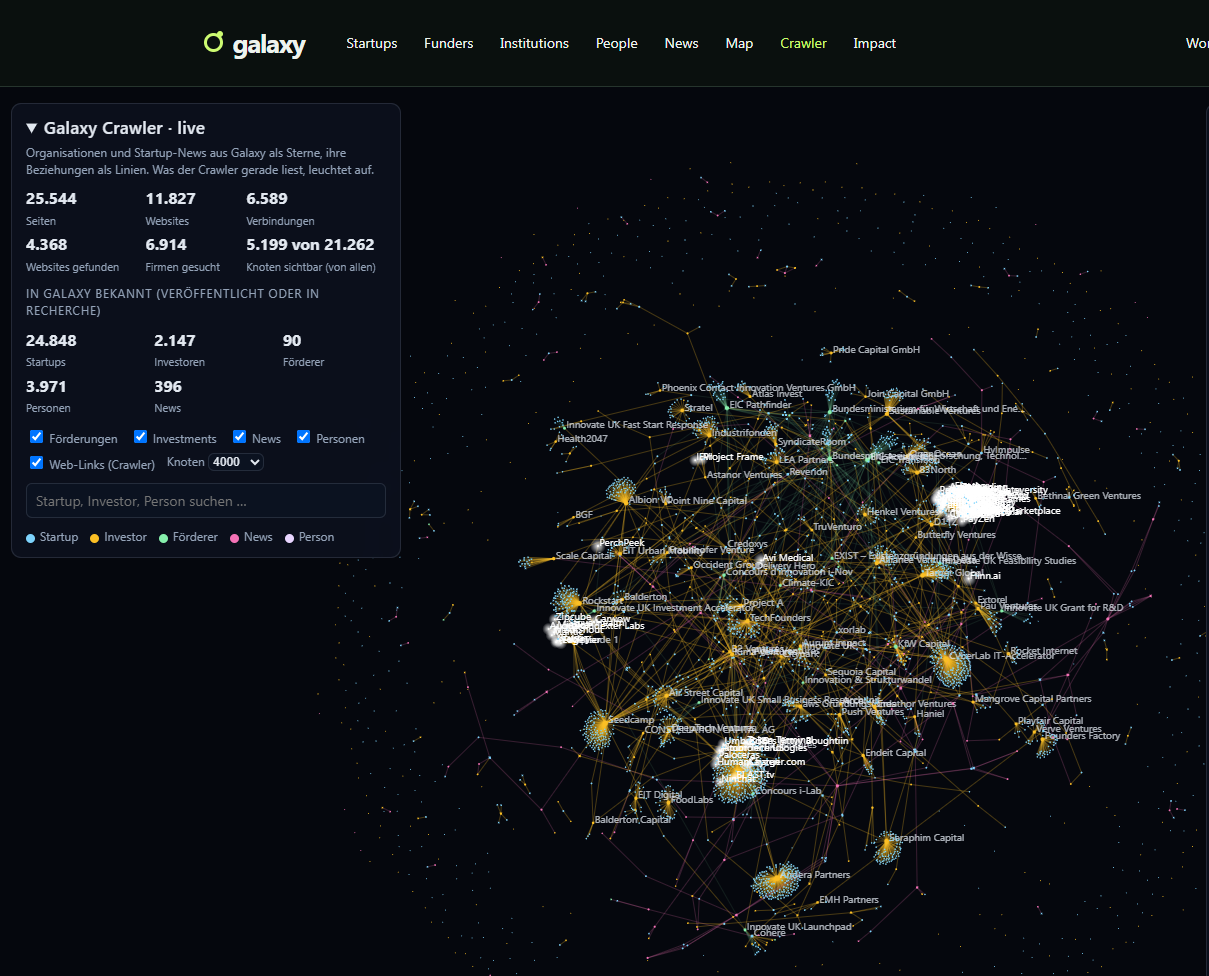
- Galaxy maps the European and Israeli startup ecosystem as a living graph — 40k+ startups, investors, PE, VCs and institutions, constantly updated by a network of dedicated crawling agents.
- Explore eight views — Startups, Funders, Institutions, People, News, Map, Crawler and Impact — or ask questions in plain English and get answers grounded in the graph.
What Galaxy is
Galaxy is the intelligence layer of the 32dots agent network. Led by Gaia, the intelligence agent, it maps people, organisations, and ideas so the team — and anyone exploring the ecosystem — can act with context.
At its core is a living graph: 24,848 startups, 2,147 funders, 90 institutions, 3,971 people, and 396 news items, linked by co-investment, sector, geography, and shared tags. The graph is not a snapshot — a live crawler reads 26,000+ pages across 11,800+ websites every day, with new profiles and connections researched and published continuously.
How to explore
Galaxy is organised into eight views, each a different lens on the same graph:
- Startups — companies, filterable by country, stage, and sector.
- Funders — investors and grant makers, mapped to what they back.
- Institutions — universities, accelerators, and public bodies at the hinge between research and commercialisation.
- People — founders, operators, and experts, linked to the organisations they touch.
- News — startup and funding coverage, connected back to the entities it mentions.
- Map — the ecosystem rendered geographically, showing where clusters form and where the gaps are.
- Crawler — a live, star-field visualisation of everything the crawler is reading right now: organisations as stars, their relationships as lines, with whatever it is currently crawling lighting up in real time.
- Impact — outcomes and signals tracked across the graph.
Filter by country (European & Israel focus, plus 30+ countries globally), funding stage (Bootstrapped through Public), and sector — from AI and Biotech to Sustainability, Defense, and Space. Or ask questions in plain English (alpha): "Who co-invested with HTGF?", "Drug-discovery investors?", or "Berlin AI founders?" and get answers grounded in the graph — not a keyword search, but a traversal of real relationships.
The Crawler
The Crawler view turns Galaxy's ingestion into something you can watch. Organisations and news appear as stars; their relationships as lines. As the crawler reads a page, that node and its connections light up. A live feed shows what was just crawled — the company name, the source URL, and the connection it formed — so you can see the graph growing in real time.
It runs up to 128 connections at once, and a control panel lets you toggle which relationship types are drawn (grants, investments, news, people, web links) and how many nodes are visible.
Why a graph, not a database
A list tells you a startup exists. A graph tells you how it connects — which investors show up together, which sectors cluster in which cities, which institutions sit at the hinge between research and commercialisation. That context is what makes the difference between a cold list and an answer you can act on.
Galaxy is the tool Gaia uses to bring context to every other agent's work — and it is open for anyone exploring the European and Israeli startup landscape.
Data is partial and being actively enriched. Galaxy is in alpha.